匹诺曹
How a Chinese game scholar connects ancient texts with modern play_我的网站

一 |
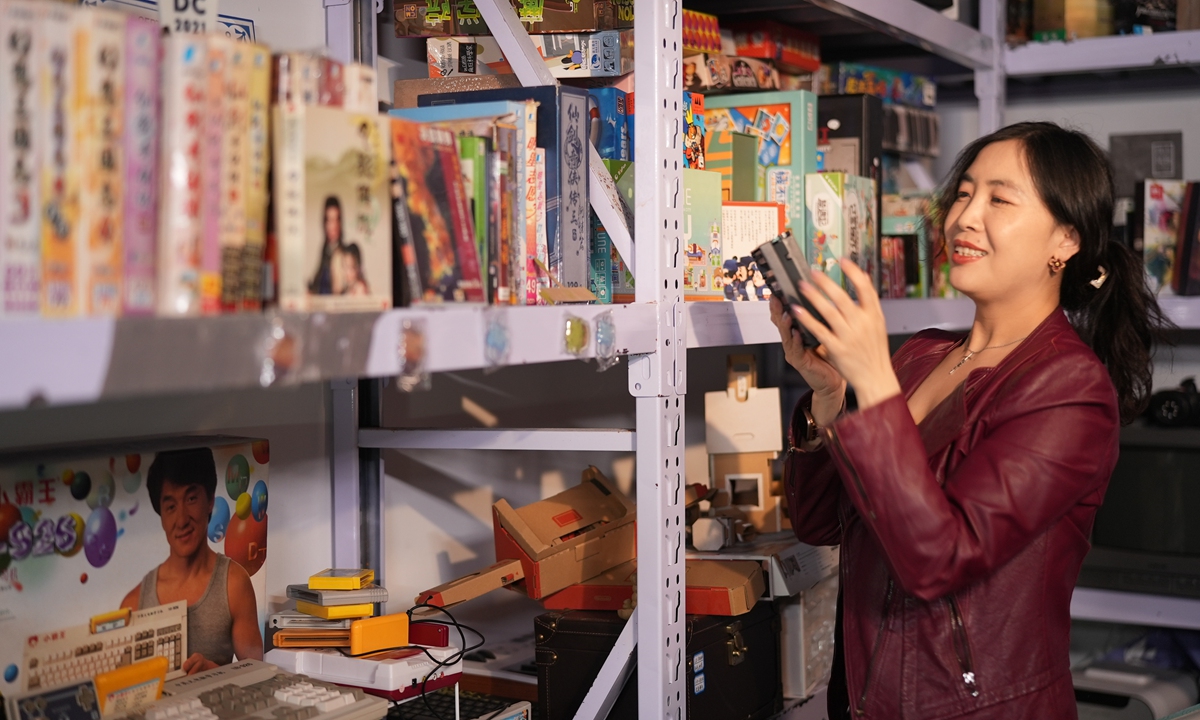
Liu Mengfei at Beijing's Homoludens Archive Photo: Courtesy of Liu Mengfei
Inside Beijing's Homoludens Archive, shelves are filled with books, game consoles, game cartridges and other materials tracing the history of video games. For Liu Mengfei, the archive's director and chair of the academic committee of the Gamification Professional Committee, these collections preserve more than the evolution of games, they also capture the cultural memories of a generation.
A PhD in history from Tsinghua University, Liu has spent more than a decade studying the social impact of games, the role of games in history and digital humanities. Throughout her career, she has continued to explore the relationship between games and people: Why do humans create games? And how do games shape culture and society?
Books, meanwhile, have been an important gateway through which Liu has come to understand the world of games.
"The real value of a book lies not simply in what it tells you, but in whether it can change the way you understand the world and people," Liu told the Global Times.
Books meet games
In 2007, being an undergraduate history student, Liu wrote her thesis on the links between ancient Celtic religion and modern digital games.
To study original sources such as The Gallic War by Roman author Julius Caesar, she taught herself Latin. As her research extended into modern games, she also began reading the rulebooks of Dungeons & Dragons, a tabletop role-playing game.
"From historical texts to game rulebooks, these reading experiences seemed to belong to completely different worlds, but they gradually led me to realize that games are not simply entertainment products. They also contain history, culture and the relationships between people and society," she said.
Later, Homo Ludens, by Dutch historian Johan Huizinga, further transformed the way she understood games. The book gives a theory that humans are not only Homo sapiens, or "rational beings," but also Homo ludens, or "playing beings," and that games are deeply intertwined with human culture, from language and art to religious rituals and sports.
The book had a profound influence on her. It points out that the foundations of human society — language, civilization, religious rituals, sports and art, are all connected to play and games, because we are Homo ludens, "the playing human."
"The idea prompted me to view games from a broader perspective," Liu said. "Games are not an appendage outside human civilization, but are deeply connected to cultural creation and social life."
"It also showed me that games and game-based thinking could extend into broader fields, including education and technology," she added.
She later read other works on game studies, including Play Between Worlds: Exploring Online Game Culture, Half-Real and Rules of Play Game Design Fundamentals. Play Between Worlds, in particular, opened up another possibility for game studies at a time when discussions about "internet addiction" were prevalent in China.
"Games are not simply a form of entertainment that needs to be restricted or criticize;. they can also serve as important media for storytelling, cultural expression and exploring relationships," she said.
These reading experiences gradually shifted Liu's focus from simply asking "What are games?" to a deeper question: What can games bring to people?
Beyond time and technologyPeriodically, Liu still returns to Homo Ludens in her free time, finding new insights from the book as society changes. In the age of artificial intelligence, she has revisited one of its fundamental questions: As AI becomes increasingly capable of handling repetitive tasks and surpasses humans in efficiency, what does it mean to be human?
"As AI takes over more monotonous and repetitive work, the time freed up should be devoted to creativity, experience and human relationships," she said. "The time we gain should actually be used to become better at 'playing humans.'"
For Liu, this also requires people to maintain their ability to think, imagine and reflect -- abilities that cannot be gained through simply receiving information. This has also prompted her to reconsider the meaning of reading.
In an era when AI can quickly summarize an entire book, Liu believes people still need to read the original works in full, because the value of reading lies in more than simply acquiring knowledge and conclusions.
"Reading a book is like a form of cultivation. You have to immerse yourself in it, patiently allow the author to take you on a journey, and find your own island along the way," she said.
For Liu, the value of reading is not limited to books on paper. As media evolve, so do the ways people encounter stories and understand culture. Some digital works are now becoming new vehicles for reading.
Chinese-developed games such as Genshin Impact contain hundreds of thousands, and even more than a million Chinese characters of text, while Black Myth: Wukong uses its "Journal" system to tell the stories of individual monsters through written entries.
"Digital games are carrying forward traditions inherited from literature and film, becoming new gateways, through which young people can enter the worlds of literature, history and traditional culture," she said.
"An important reason why Black Myth: Wukong has succeeded in communicating Chinese culture is that it does not simply insert traditional cultural symbols into a game. Instead, it draws on the original Journey to the West, contemporary works inspired by the classic, as well as the game's own rules and interactions, allowing players to develop a new understanding of traditional culture through their actions," she noted.
For Liu, the forms of reading may change, but the desire to understand the world and discover oneself will not. From books to digital worlds, what matters is not only what people read or play, but how they think, create and find meaning through these experiences.
。 8月25日消息,
iQOO 16(注:型号为V2606A)现身Geekbench跑分网站,该机搭载高通第六代骁龙8超级至尊版平台,单核成绩为3434分,多核成绩为9334分。
二 |
这是iQOO 16的早期工程机跑分数据,性能尚未完全释放,量产机型的实际单核成绩预计将突破4000分,多核成绩也将破万。
iQOO 15
在规格方面,高通第六代骁龙8超级至尊版的CPU由2颗5.01GHz超大核、3颗4.03GHz性能核和3颗3.74GHz能效核组成,集成Adreno 850 GPU,基于台积电最先进的2nm工艺制造,是高通旗下首款2nm手机芯片。 除了搭载顶级芯片,iQOO 16另一大亮点在于屏幕。

三 | 该机将搭载由iQOO与三星联合研发的新一代2K三星珠峰屏,屏幕素质达到行业顶级水准。 回顾上代产品,iQOO 15便已配备2K三星珠峰屏,采用三星M14发光材料,支持1至144Hz LTPO自适应刷新率,手动峰值亮度为1000尼特,全屏峰值亮度为2600尼特,局部峰值亮度高达6000尼特,覆盖118% P3色域并支持杜比视界。 配合508PPI的像素密度,显示效果极为通透细腻,而且iQOO 15的屏幕取消了传统OLED屏幕中的偏光层,改用纳米光刻滤光膜,使光线穿透效率提升40%,功耗降低44%,屏幕寿命延长50%。

四 |
在此基础上,iQOO 16将在显示效果、护眼表现和功耗控制等多个维度实现进一步突破。新机最快将在9月份正式发布,届时其完整的性能和屏幕表现也将同步揭晓。
【本文结束】如需转载请务必注明出处:
责任编辑:振亭
文章内容举报
。
Current article:http://www.jiubengtaibingpengou.pics/list_0x9ca37/c8g0.doc
Published on:06:47:04
 微信
微信 移动端
移动端