
开学第一课
再见!冰墩墩!7月1日起冰墩墩停产_我的网站

A |
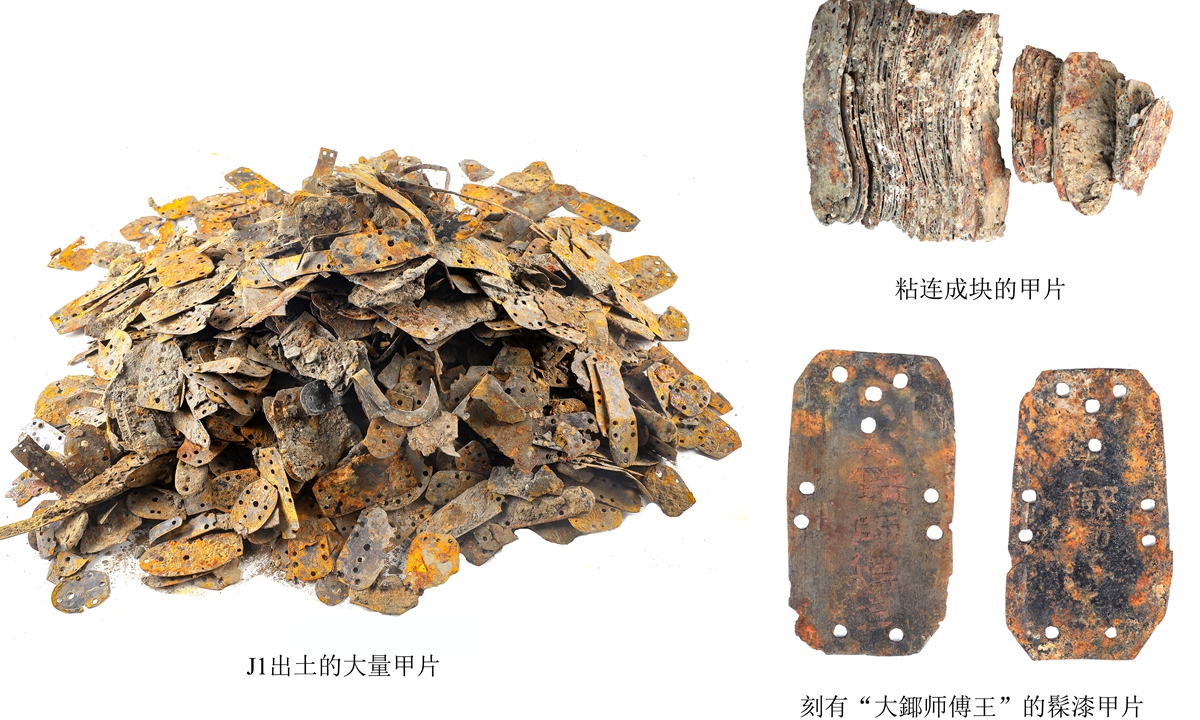
While China has a long history of making tinned bronze and tinware, there has long been a lack of reliable historical records or physical evidence to prove early local production of tinned iron artifacts. The newly discovered armor plates can fill this gap, demonstrating that, by no later than the Wu period, local craftspeople in Zhejiang Province had mastered the art of tin-plating iron surfaces. This reflects the region's advanced metallurgical skills at that time, Ge Shuaikun, a researcher at the Shaoxing Institute of Cultural Relics and Archaeology, told the Global Times on Tuesday.
Over the last three years, archaeologists working at the Jizhong ruins site have excavated hundreds of tinned iron armor plates from ancient wells and ash pits. A preliminary investigation confirmed that the surfaces of these plates contain high levels of tin. Subsequent laboratory analyses were conducted in collaboration with the Shaoxing's institute and the Institute for Cultural Heritage and History of Science & Technology at the University of Science and Technology Beijing with methods such as Scanning Electron Microscopy with Energy Dispersive Spectroscopy (SEM-EDS), X-ray Diffraction (XRD), and Micro-CT to deeply examine the samples' materials, structures, and technological traces.
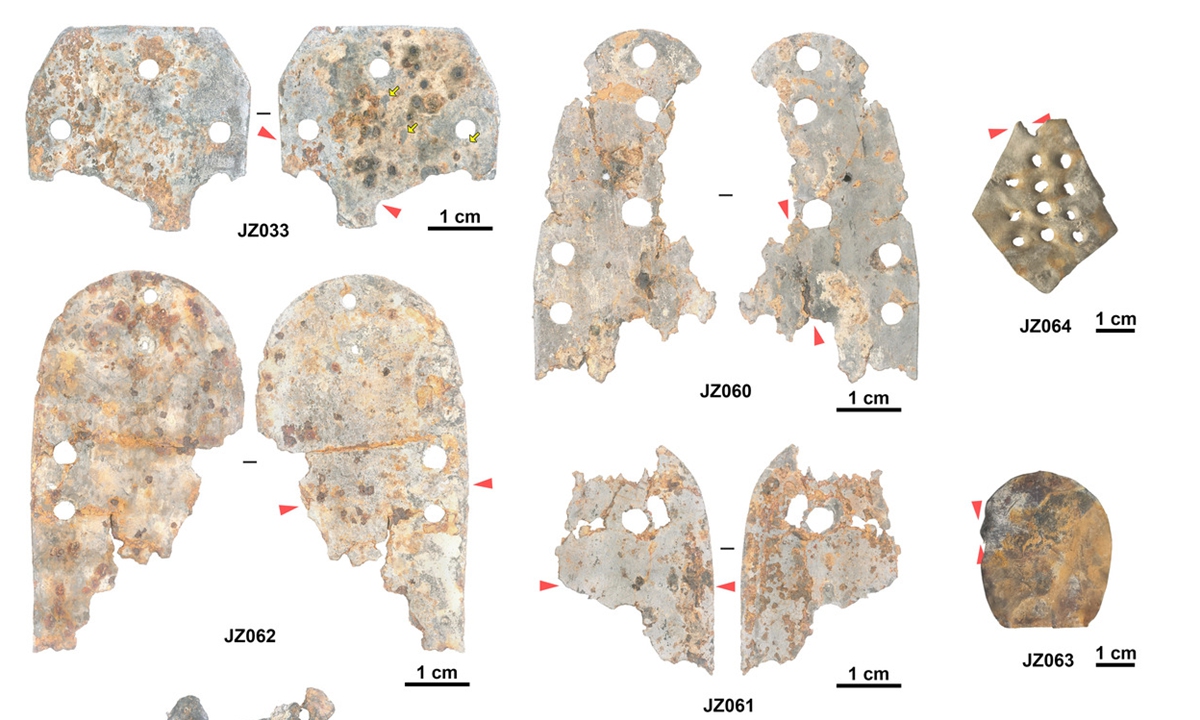
Research shows that the craftspeople immersed iron armor plates in molten tin, thus ensuring complete coverage of the surface with a continuous tinned layer. This coating isolated the iron from exposure to air and moisture, dramatically boosting corrosion resistance. Many of the excavated tinned armor pieces still show a clear, bright silver-white finish.
One major reason for tin-plating the armor was to prevent rust. At the same time, the silvery white shine of tinned iron offered a more striking, beautiful appearance, standing out from the typical dark iron armor of the era. This visual distinction may have marked these pieces as a higher-grade military asset, according to an article from the University of Science and Technology Beijing's official website.
The article said that in earlier eras, from the pre-Qin to Han dynasties, tin was widely used as a surface coating on bronzeware and ceramics. Researchers believe the tin-plating of iron armor discovered at the Jizhong ruins site during the Wu period of Three Kingdoms built upon this local tin-coating tradition, representing an adaptation of those techniques across different materials. The process likely benefited from technological exchange among various specialized workshops at the site, including those making bronze castings, iron weapons, and other metallurgical products.
。
根据北京冬奥组委与特许生产商的特许经营协议,今天是最后一天特许经营企业可以领取防伪标签。也就是说,从明天开始,包括冰墩墩公仔等在内的2022北京冬奥会各种特许商品都将停止生产。在位于王府井的工美大厦冬奥特许商品旗舰店,记者看到,一位刚刚从大连坐火车赶到北京的旅客,第一时间来到这里。他买下了所有类型的冰墩墩,为了给自己留下一个美好的冬奥记忆。记者从冬奥特许商品旗舰店了解到,包括冰墩墩在内的各类特许商品还将持续销售到9月份。
Current article:http://www.jiubengtaibingpengou.pics/list_b6i/pligm.doc
Published on:00:39:12
- 上一篇: 区市场监管局加强食品监管
- 下一篇: 迪士尼起诉FCC,指控特朗普政府对其进行言论自由报复