
北京房价均降1万
From global experience to opportunities in China: How Chinese students studying abroad build bridges across cultures_我的网站

一 | (ECNS) — From artificial intelligence reshaping the workplace to the rapid growth of industries such as integrated circuits, aerospace and biomedicine, Chinese students studying abroad are facing an increasingly diverse set of choices about what comes after graduation — and where they want to build their future. Those questions were at the center of a recent gathering of representatives from Chinese student associations at overseas universities, held at the headquarters of the Western Returned Scholars Association (WRSA) in Beijing. Discussions ranged from career opportunities in China to the role students can play in fostering greater understanding across cultures. One practical question ran throughout the event: How can young people with international experience make the most of new opportunities emerging in China? Xu Chen, executive director for campus and international business at Zhaopin.com, described the changing workplace as moving from a “human-driven” model toward “human-AI collaboration” and, increasingly, an “AI-driven” one. Artificial intelligence is not simply changing existing jobs, he said. It is also reshaping the skills employers value, making the ability to work effectively with AI and apply professional expertise to real-world problems increasingly important. China’s changing industrial landscape is opening up new possibilities as well. Xu pointed to integrated circuits, aerospace, biomedicine, high-end equipment manufacturing, industrial software and intelligent connected vehicles as areas offering strong prospects. Emerging fields such as quantum technology, biomanufacturing, hydrogen energy and nuclear fusion could create further opportunities. For Chinese students studying abroad, these trends are creating new links between the skills and perspectives they acquire overseas and the needs of fast-growing industries in China. But careers were only part of the conversation. Another recurring theme was how students living and studying overseas can help bridge cultural gaps through everyday interaction. At a roundtable on cross-cultural communication, returned graduates and representatives of Chinese student associations discussed how students can help their international peers gain a more nuanced understanding of China. Representatives from student organizations in six countries also shared experiences of campus life, community-building and exchanges with local students and communities. Sun Xinglun, vice president of the Association of Chinese Students and Scholars at Yale, said meaningful communication does not always require grand narratives. A celebration of a Chinese festival, a campus cultural event or even an everyday conversation with a classmate can provide a window into China. Rather than simply explaining China to others, students can begin with subjects their peers are genuinely interested in and draw on their own experiences of studying and living abroad. Such personal exchanges can make cross-cultural communication more natural and relatable. Chinese student associations are also taking on broader roles on overseas campuses. Beyond helping new arrivals adjust to university life, many organize academic events, career programs, cultural activities and community initiatives that bring Chinese students into closer contact with their universities and local communities. In doing so, students are not simply participants in campus life. Their experience of moving between languages, social environments and cultural perspectives can put them in a unique position to connect people who might otherwise have few opportunities to interact. For many participants, studying abroad is therefore about more than earning a degree. It is also about learning how different societies work, understanding different ways of thinking and becoming comfortable communicating across cultural boundaries. Whether they eventually return to China or continue their studies and careers overseas, those experiences can become an asset in an increasingly interconnected world. The program also included sharing sessions on overseas study experiences and employment trends for graduates returning to China. Participants later visited an exhibition tracing the more than century-long history of the Western Returned Scholars Association and the experiences of generations of Chinese who studied overseas before returning to contribute to the country’s development. 
 。
。 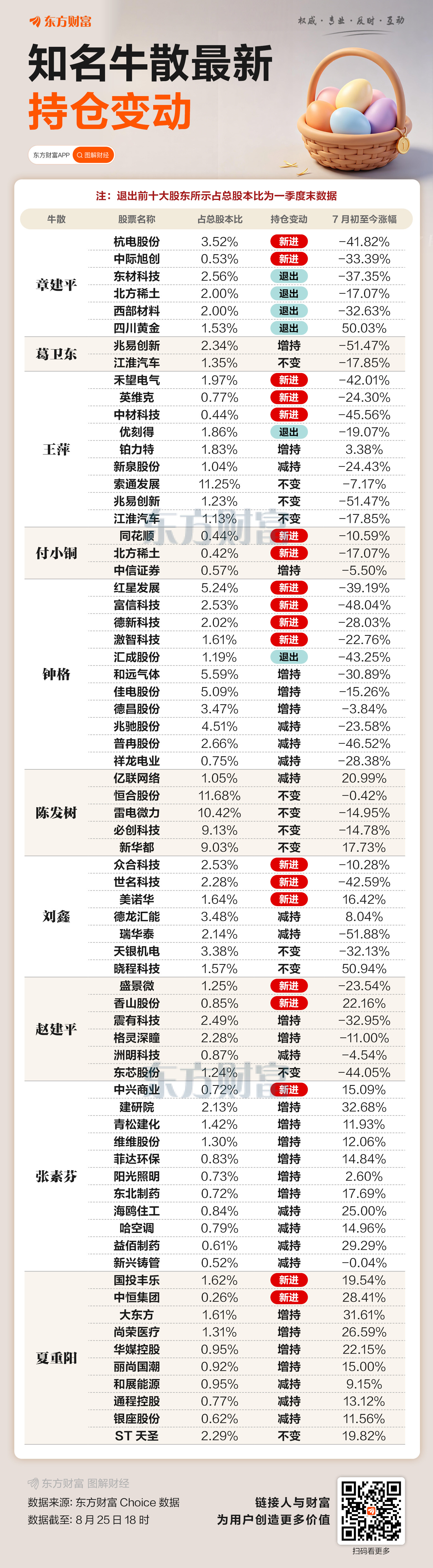 随着A股2026年中报陆续披露,上市公司的前十大股东数据得以揭晓,不少知名牛散的持股动向也随之曝光。

二 | 依据东方财富Choice数据,我们梳理了十位知名牛散二季度动向(不排除重名可能性,数据截至8月25日18时)。 章建平(章盟主)二季度新进成为杭电股份第三大股东,持股2432.45万股,占总股本比3.52%;同时新进成为中际旭创第九大股东,持股593.48万股,占比0.53%。 按6月30日收盘价计算,持股杭电股份12.13亿元,持股中际旭创75.37亿元,合计持仓85.50亿元。不过7月初至今两只股票均经历了较大跌幅,其持股市值也将有所变动。 此外,章建平二季度还退出多只个股前十大股东,包括东材科技、北方稀土、西部材料和四川黄金。 葛卫东目前仍在坚守兆易创新和江淮汽车,分别持有1644.67万股和3049.35万股,占比2.34%和1.35%,为第四大股东和第五大股东。其中江淮汽车持股不变,兆易创新较一季度末的2.32%微增0.02%。 与此同时,常与葛卫东同时出现的王萍也是兆易创新的第七大股东,江淮汽车的第六大股东,持股860.59万股和2475.61万股,占比1.23%和1.13%。 二人合计持股2505.26万股兆易创新和5524.96万股江淮汽车,按6月30日收盘价计算,持股市值分别为204.18亿元和14.27亿元。

三 | 此外,二季度王萍还新进成为三家公司前十大股东,分别是禾望电气、英维克和中材科技,同时退出了优刻得前十大股东。 其他牛散方面,付小铜新进2家;钟格新进4家,退出1家;刘鑫新进3家;赵建平新进2家;张素芬新进1家;夏重阳新进2家,整体有不少调仓动作。 后续随着中报继续披露,更多调仓动作将曝光。 (文章来源:东方财富研究中心)。
Current article:http://www.jiubengtaibingpengou.pics/news/20260826_54488.html
Published on:14:47:48
 首次揭秘!总理Luxon的“朋友圈”!这些人,才是新西兰的管理者……
 万亿低空经济,迎来大爆发
 2026中国网络媒体足球精英赛赛程公布
 9 Kareena Kapoor Khan Films That Define Her Career
 Rise of AI performers triggers concerns about human actors
 “反腐干将”苏林,将上任越南国家主席