
正能量
以日本现在的实力,真能打赢俄罗斯吗?俄结束战斗只需一天,洞察军事,原创 以日本现在的实力,真能打赢俄罗斯吗?俄结束战斗只需一天_我的网站

一 |
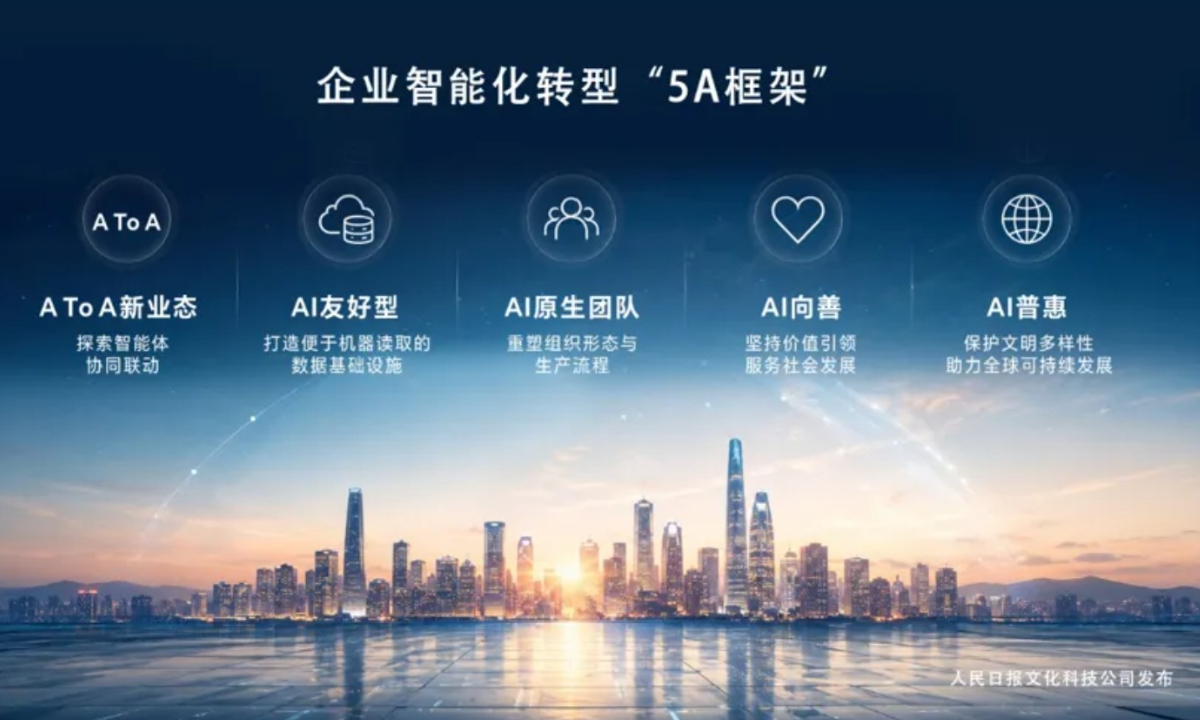
The 2026 Digital Intelligent Economy Forum was held in Langfang, North China’s Hebei Province, on Wednesday. At the forum, organizer People's Daily Cultural Technology Corporation unveiled a “5A Framework” for enterprise intelligent transformation, aimed at helping businesses comprehensively innovate their business models, organizational structures and service systems in the artificial intelligence (AI) era.
A To A: Exploring new models for agent collaboration
AI is pushing the internet into a new stage characterized by the widespread participation of AI agents. In the future, China could develop an ecosystem comprising tens of billions of agent applications, while the global “digital population” could reach hundreds of billions. Following To B (business-oriented) and To C (consumer-oriented) models, enterprises and institutions should actively explore the emerging To A (agent-oriented) model. To enable better interaction and coordination among agents, unified data, technology, interface and service standards need to be established, while new business systems and service models should be cultivated.
AI-friendly: Building machine-readable data infrastructure
Today’s internet user interfaces are primarily designed for human browsing. The first step, therefore, should be to build an “AI-friendly” data system that is better suited to being read, understood and accessed by AI. By structuring content resources and turning them into organized knowledge, while strengthening ontology systems and knowledge graphs, such a system can improve AI’s ability to understand and apply information. On this basis, integrated hardware and software infrastructure combining computing architecture with data systems can be developed for AI applications.
AI-native teams: Reshaping organizations and workflows
AI is profoundly reshaping organizational structures and ways of working. AI-native teams should redefine job responsibilities, organizational structures and business processes around the A-To-A model and AI-friendly services, enabling “everyone to have multiple AI agents.” Professional capabilities and business experience can be encapsulated into “digital employees,” promoting autonomous learning by agents, multi-agent collaboration and the evolution of collective intelligence, thereby multiplying per-capita productivity.
AI for good: Putting values first, serving social development
AI also requires values-based guidance. Guided by the principle of “being people-centered and using AI for good,” efforts should follow the approach of “governing AI with AI and guiding intelligence with wisdom,” ensuring that AI always serves social development, the public interest and people’s needs. The “Mainstream Values Corpus,” whose development was launched by the People’s Daily in May 2023, has already begun to take shape and has been validated through numerous large-model applications.
Inclusive AI: Protecting cultural diversity, advancing global sustainable development
AI should not become merely “a game for rich countries and rich people,” but should benefit all countries. Efforts should be made to actively participate in global initiatives for inclusive AI, bridge the digital and intelligent divide, and enable more organizations and individuals to share the benefits of development on an equal footing, so that AI can truly become a powerful positive force for improving the well-being of all humanity and advancing human civilization.
This was translated and compiled by the Global Times, based on an article originally published on people.cn on August 12, 2026.
。

二 | 日本和俄罗斯,一个是经济科技强国,一个是军事核大国。

三 | 这两家要是真打起来,结果会怎么样?俄罗斯方面有人曾放过话,说结束战斗只需要一天。 俄罗斯真那么厉害吗,是不是在吹牛呢?其实不是,俄军真有这个实力。 目前日本自卫队总兵力25.5万人,装备精良,海上自卫队和航空自卫队的装备水平放,在亚洲甚至世界都是一流水漂。

四 | 尤其是海上力量,日本有大量现代化驱逐舰、护卫舰,还有出云级准航母和AIP潜艇,反潜和防空能力极强。航空方面,日本在逐步换装隐身战机F-35,机队规模不小,一旦全部交付,数量超百架。单看常规装备的质量,日本超过大多国家。 但日本有个短板:日本自卫队是一支“专守防卫”的力量。战后宪法限制它不能拥有进攻性战略武器,没有远程轰炸机,没有弹道导弹,更没有核武器。

五 | 日本最强的海上力量,核心任务是保护海上交通线和配合美军反潜,不是远征打击。 而俄罗斯常规军力这些年退化明显,尤其是海军,苏联时代留下的底子老化严重,新舰补充缓慢。但俄罗斯手里有两样东西,让日本望尘莫及,那就是核武器和战略纵深。 俄罗斯的核武库跟美国一个量级,战略火箭军手里握着上千枚核弹头,从洲际导弹到潜射导弹再到战略轰炸机,三位一体的核打击能力齐备。

六 | 日本没有核武器,也基本没有反导拦截洲际导弹的能力。一旦冲突升级到核层面,日本连还手的本钱都没有。这就是俄方说“一天结束”的底气所在。 俄罗斯不是用常规部队,一天就能打垮日本,如果真动手,俄罗斯可以在短时间内,用战术核武器甚至战略核武器,让日本丧失抵抗能力。 当然,常规战也不好打。俄日之间隔着日本海,俄罗斯要登陆日本本土,难度极大。日本海上自卫队反潜世界一流,俄罗斯的潜艇优势会被抵消。所以如果只是常规摩擦,日本能扛住一阵,俄罗斯也不会轻松。 但战争不是擂台赛,打到后面比的是意志和底牌。俄罗斯是核大国,日本是美国保护下的非核国家。这一点就注定了,日本在跟俄罗斯单独较量时,天花板很低。日本能把俄罗斯舰队挡在家门口,却挡不住从西伯利亚飞来的核弹头。 还有日本没有战略纵深。几个大岛人口密集,工业集中在东京湾到濑户内海一线,俄罗斯的远程航空兵和导弹部队真动手,日本的核心地带全在射程内。 而俄罗斯远东相对地广人稀,日本想打到莫斯科,得横跨整个亚洲大陆,这还不算俄罗斯的防空系统。

七 | 所以,日本对俄罗斯,最好的选择就是别打。美国在的时候,日本还能狐假虎威一下;一旦单独面对俄罗斯,日本的常规优势会被核优势抵消,地理优势会被战略纵深抵消。 俄罗斯说一天结束战斗,真不是在吹牛。 日本这些年一直想把自卫队变成“正常军队”,修宪、买F-35战斧远程导弹、造准航母,足见日本的野心了,如今日本自卫队距离成为正规军,也只差一步,不得不防。返回,查看更多。
Current article:http://www.jiubengtaibingpengou.pics/news/20260826_850.html
Published on:10:37:01


1
抽废料 炼黄金!超爽解压增量《吸吸吸有限公司》明日发售!2
父亲参加革命15年杳无音信,儿子寻亲被抓壮丁,抗美援朝意外相逢,乡村大锋,原创 父亲参加革命15年杳无音信,儿子寻亲被抓壮丁,抗美援朝意外相逢3
投诉美团外卖湘乡米粉北辰店卫生不达标问题4
उत्तराखंड में शिक्षकों को अंतरिम पदोन्नति का तोहफा, शिक्षा मंत्री के अधिकारियों को जारी किए निर्देश5
中日英联手抛售美债,特朗普威胁出动美军“救市”,王雨田观察,原创 中日英联手抛售美债,特朗普威胁出动美军“救市”6
节前针对邮政工作人员的暴力行为增多,邮局提醒人们尽快寄出礼物7
政声直达|京冀首条跨省地铁开启空载试运行8
18.9万人爆仓!比特币狂飙 本周累涨超24% 创2023年3月以来最大单周涨幅9
彻底完了!正式转卖股权!佩总恐下课!怒砸4.46亿,东契奇天塌了!10
三星 2026 上半年研发投入超 27 万亿韩元,全球专利总量逼近 30 万件11
Readers’ Reflections: China’s innovation success is real global news, landing in the living rooms of Italian retirees who barely use a smartphone: Italian scientist12
龙港区消防救援大队开展消防安全知识培训暨逃生应急演练活动13
[인사] 재정경제부14
新时代文明实践 | 钱清街道开展“与梦想童行”中国梦想日主题活动15
受权发布丨国务院关于修改和废止部分行政法规的决定
- 随机推荐
1
伊朗放出信号:愿与美直接对话2
无名女尸细节披露:穿中国老纺织厂背心,华人社区成破案关键3
顺丰运索尼镜头磕碰故障申请赔偿1600元差价4
2025粤港澳车展:雷克萨斯NX 260湾曜特别版亮相5
受强降雨影响,河北多条高速部分路段高风险6
油价将迎来今年第二跌!油价调整最新消息2024 新一轮油价调整时间4月29日!7
英媒:上赛季切尔西场均跑动距离英超垫底,本赛季首轮后第一8
国际素食日 | 愿我们的一顿素食,让身体和地球一起健康!9
广东茂名电白区开展龟类养殖交易行业排查整治行动10
中消协发布消费提示:使用人工智能服务需谨防误导11
小卡仍有望回猛龙!ESPN:相信交易会完成12
欢乐过寒假 安全不放假——郑州商学院附属点点幼儿园2025年寒假放假通知及温馨提示13
区妇联开展在职党员进社区活动14
国内多地已开始供暖,网友:我还在吹空调!_气温_根河市15
China crackdown on cyber scams nets thousands but leaves networks intact